
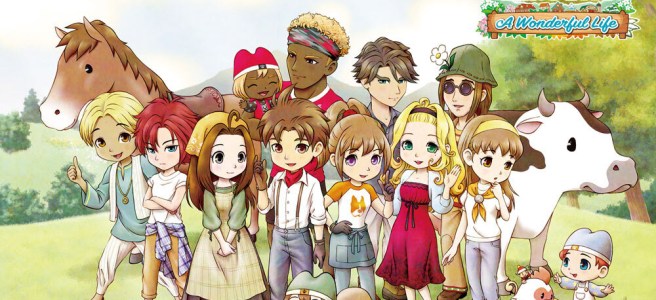
For the March 2023 issue of Nintendo Dream, Hikaru Nakano (The producer of the Story of Seasons series) and Rika Hoshina (the director for Story of Seasons: A Wonderful Life) were interviewed regarding various aspects of the game. Thanks to the collaboration of @artycharmy and @regularcelery, we can share the information with English speaking fans!
—————
Interviewer: To start, first please tell us about what makes this game appealing.
Hoshina: The appeal is that you get to simulate and experience another life. Out of the Story of Seasons series, this title stands out for illustrating a few decades within six chapters. As chapters progress, of course the village changes but so does the main character’s appearance, way of thinking, relationships and so on. You can clearly see the progression of time which is what makes it appealing.
Interviewer: Why did you decide to remake Harvest Moon: A Wonderful Life (2003, Gamecube), which is so different from the rest?
Nakano: There’s no one particular reason why this game was remade. We decide games when everything falls into place, like timing, the team, staff issues and so on. Although this was before we started using social media, a lot of players had kindly told us that this is a very memorable title to them. Those comments definitely helped push us. I also really liked how deep this entry was so I was always looking for a good chance to remake it.
Interviewer: Besides the player’s kind comments, was there anything else that pushed you to remake it?
Nakano: This has always been a very well known piece overseas, so the fact that the overseas staff were on board was another big reason.
Interviewer: Were there any new concepts you put in when remaking it?
Hoshina: A new concept in the remake is “Live life together with your family.” While trying to preserve the joy of simulating another’s life from the original, we added elements where you can feel normal, everyday family life.
Interviewer: How long were you working on the remake for?
Nakano: We started talking about plans for a remake in Spring 2020. We probably started to actually work on development around Autumn the same year.
Interviewer: Compared to the original, how much did you alter the character’s lines?
Hoshina: The original lines haven’t really changed much overall. Most of what’s been changed are basic adjustments like how kanji is used and unifying syntax. Of course, for various reasons some phrases have been changed, but we developed it with the policy that we reserve each line the character’s had in the original as much as possible to stay true to the characters.
Interviewer: Please tell us about how the animals no longer pass away in the remake.
Hoshina: We thought a lot about how to express life for animals during development. In the latest Switch titles, say Story of Seasons: Friends of Mineral Town (2019) or Story of Seasons: Pioneers of Olive Town (2021), we adopted the system of cherishing your animals forever without them ever passing away, which is becoming the norm for Story of Seasons. We were concerned that if we revived the mechanism of animals passing away amongst this change that it’d be unimaginably stressful. It’s something we really thought a lot about, but in the end we settled on expressing life in ways besides passing away.
Interviewer: It’s something you thought a lot about?
Hoshina: Yes. In the remake now goats and sheep can give birth and we stepped up on frequently showing the positive sides of life. We hope you can feel that the farm animals are alive whenever a baby animal is born.
Interviewer: I feel as though the animals’ designs have become a little cartoonish.
Hoshina: The cartoonish designs are following the trends of the recent games, which are a project started by Nakano. Since more cartoonish designs have been used since the 3DS to most recent entries, we went with cartoonish designs to not suddenly change our art direction.
Interviewer: I see. On the other hand, why are only the cows realistic?
Hoshina: About the cows…
Nakano: We went through a lot, didn’t we?
Hoshina: Actually, I just couldn’t completely give up on the more realistic cows halfway through development so I convinced Nakano to change them, haha. The cows are the face of Story of Seasons. The bubble cows in Story of Seasons: Pioneers of Olive Town are cute, but I was pretty set on using the cows from the original A Wonderful Life. After deciding to use cows close to the original ones, we slimmed down the bodies of the other animals and made other overall adjustments.
Interviewer: So that was something you weren’t willing to let go of.
Hoshina: By the way, the bubble cow hasn’t completely disappeared. It makes a proper appearance in the game as a mascot character.
Interviewer: Was there anything in particular that you wanted to change during development?
Hoshina: I love the original. It’s a game I played a lot of in real time. However, our impression was honestly that it would be difficult to implement.
Interviewer: What do you mean by difficult?
Hoshina: Games that grow on you as you play require time, getting used to and skill until you come to understand how interesting they are, don’t they? That’s what we thought would be difficult. When we looked at the thoughts of those who played the original, there were quite a few who didn’t notice all the things you can do in the game. We felt a lot of things would be missed.
Interviewer: You’re saying there were some people who couldn’t do everything in the game.
Hoshina: On the other hand, one of the big appeals of Harvest Moon: A Wonderful Life is building up your farm by fumbling around while you don’t know left from right. Finding the right balance was tough.
Interviewer: Exactly what kind of adjustments did you make?
Hoshina: Firstly, we came up with ways to get people to know how to enjoy working on the farm. With the new signboard feature, players can learn about new gameplay elements and see the charm of characters in new events. We added these elements in a way that they never force the player to do anything. Other than that, we made getting to the ending shorter so that more people can play the game in its entirety. However, we compensated what was shortened by increasing movement and work speed. You can manage how much work you do in a day.
Interviewer: I heard that over 70 different new events have been added. Speaking in terms of chapters, in what chapters did you add events?
Hoshina: In chapter 1, we added events related to the marriage candidates and from chapter 2, a lot of family related events. Other than those, we also prepared a few events for completionists.
Interviewer: What is your aim for adding so many events?
Hoshina: When we were finalizing plans for the remake, we came to the conclusion that the heart of Story of Seasons: A Wonderful Life is “life”. We defined this as made by the many memories you see when you reflect on the hours you spent playing as you head towards the end of the game. Naturally, a lot of events were added when we were thinking about ways to strengthen the aspect of memories in the remake.
Interviewer: Is there anything in particular you want us to see out of the events you added?
Hoshina: We put quite a lot of effort into the special dates with the marriage candidates that happen post proposal. Opposed to romance events, where we show you getting closer and closer to the candidate, the post proposal events help you imagine your future everyday life with your spouse. Depending on the character, you might be able to discover something exciting about them.
Interviewer: What’s your top recommended event?
Hoshina: Personally, I love events with the kid and Takakura. I think the conversations between Takakura, who can’t grasp the distance between them, and the child, who’s carefree, are cute and… If I continue I’ll keep on talking so I’ll stop here. I’d love it if you saw them for yourselves.
Interviewer: We feel as though the graphics have the look of a picture book. What concepts in regards to graphics did you have for the remake?
Hoshina: People might feel that the remake has the looks of a picture book compared to the original. However, as a development policy, we were focusing on how to carry over the realistic atmosphere of the original.
Interviewer: If that’s the case, where could this difference be coming from?
Hoshina: Even though Story of Seasons is just one series, it has undergone some big style changes over the past 20 years. If we compare the pre-released original with recent entries, I think most people would regard the recent games’ graphics as quite bright and cheerful. We decided on a realistic atmosphere, in which we deeply considered all the graphical changes over the past 20 years. Although the remake carries over traits of the original, like the realistic-ish scenery, we were conscious of not changing the true flair of the series, which is a mix of unrealistic elements sprinkled here and there.
Interviewer: Please tell us about how the male marriage candidates have undergone big changes, like appearance and Gordy (Cody) becoming a marriage candidate.
Hoshina: This is related to the production circumstances at the time. The original was produced with a male protagonist but the next, Harvest Moon: Another Wonderful Life, was produced with a female protagonist, which led to the marriage candidates being chosen from pre-existing characters. In other words, Marlin, Rock and Gustafa weren’t originally designed as marriage candidates.
Interviewer: It’s a well known fact among fans, isn’t it?
Hoshina: Since it’s a remake, those 3 were marriage candidates from the beginning. So, we asked Igusa Matsuyama (An illustrator and manga artist who’s done most of the work for Story of Seasons) to add marriage candidate qualities to them. These additions are one of the reasons why their appearance has changed so much.
Interviewer: Not only the male marriage candidates but all of the character’s have gotten a modern update, too. What kind of things did you keep in mind when changing them?
Hoshina: The character designs in the remake were built around the thought that, “When players who know nothing about the original see the remake, will they be able to interpret the characters as we intended with the mindset of someone from 2023?” This applied to not only the marriage candidates but all characters. For example, when you imagine young people who worked in the city in 2003 and those in 2023, I think what comes to mind are two completely different images. I feel we made big design changes to characters who needed to reflect a changing sense of values. We chose these designs after listening to overseas companies because the game is in store for an overseas release too, so they reflect not only Japanese views but a wider audience.
Interviewer: So it’s a change that occurred while keeping an international release in mind.
Hoshina: Of course! The core of the characters haven’t changed so the redesigns are in no way intended to deny anything about the original. I myself like the characters in both the original and remake, so we’d appreciate it if you could see these changes as following how time has changed over the past 20 years.
Interviewer: In contrast to the male marriage candidates, the female ones don’t seem to have undergone any big changes. Was there anyone you were conscious about altering?
Hoshina: Lumina’s redesign took a lot of work. Due to aging her up to 18, design wise I had trouble making her look like an adult but immature on the inside. I went through a lot of trial and error until I eventually settled on the clothes she has now, which are close to her original design. I made her so that when anyone looks at her they either see a grown woman of today or catch a sense of her childlike spirit. I hope you can more strongly see her as a child that was raised in a community of only adults.
Interviewer: Is there also romance in the candidate events you added to the remake?
Hoshina: As for new romantic elements, there are candidate events after just meeting them and special dates post engagement.
Interviewer: We’re surprised with how much effort you put into the events.
Hoshina: Story of Seasons A Wonderful Life has characters who you find charming after you get to know them well. We added the first encounter scenes to help you learn one good thing about the characters. We hope that through these first encounter events that you can get interested in all the different marriage candidates.
Interviewer: What are the post proposal dates?
Hoshina: Post proposal dates are added to illustrate the time you’re dating the marriage candidates. I want to let players enjoy seeing what kind of conversations the two have after becoming a couple and if the relationship has changed after they start playing the game themselves.
Interviewer: The layout of the farm has changed a little compared to the original, right?
Hoshina: We’ve adjusted the farm’s layout partially in the remake. The tool shed was cut as an adjustment that followed a change in game mechanics. Also, we moved shipping and ordering outside to streamline the workflow. All of these adjustments were made so that players could play with ease.
Interviewer: Yeah, you can know what season it is when you’re buying seeds now. It’s much more convenient. Is there anything else you altered for ease of play?
Hoshina: One big change from the remake is we made the main character’s friendship status with the villagers visible. The gap between dislike and like in these relationships is pretty big. Even compared to other series where you befriend characters, the system is pretty unique. Consequently, it took a lot of trial-and-error to get it right. Something good might happen if you make a lot of friends so check out your friendship status sometimes.
Interviewer: Have you adjusted the protagonist’s movement speed and time progression?
Hoshina: We’ve adjusted his movement and work speed so that it’s faster than in the original. We’ve sped up time progression accordingly.
Interviewer: What was behind the images displayed on the load screen when players slept in bed?
Hoshina: They represent dreams. We made a couple of different ones so please try to find all of them!
Interviewer: The game is about to be released! A message to all the people who are waiting to play the game, please.
Nakano: I think players who played the Gamecube and PlayStation 2 versions of the game will find the parts that haven’t changed nostalgic and the parts that are new or made easier to be refreshing. On the other hand, for people who are playing it for the first time, I hope you enjoy living together with the unique villagers of Forgotten Valley and the wonderful feeling of playing out the protagonist’s life, which is a unique joy to this game.
Hoshina: Personally, I’m so happy that I had the chance to remake this game because I love it so much! Even for people who have never played Story of Seasons, I think this is the perfect game for those who feel like getting the most out of a slow, relaxing life. I too first started the series 20 years ago with Harvest Moon: Another Wonderful Life, so please, start your life on the farm now! Also, we developed Story of Seasons: A Wonderful Life while honoring the original so that old fans can be satisfied with it. We included a lot of new things to discover in the game so I think you might enjoy finding all the differences while you play! It’ll be released very soon so please look forward to it!
Interviewer: Is being able to milk your cow for only a period of time still in effect?
Hoshina: It’s something we thought about a lot but no, it’s not in the game. We didn’t set a limit on how long you can get milk from the cow but we did add a mechanic which increases the amount of milk you get after your cow gives birth. We set out to make it so that you still have the means to carefully plan effective dairy farming plus create a gameplay style where you can cherish and keep raising the same cows forever.
Interviewer: What exactly about farm work have you improved?
Hoshina: We aimed to make working in the field easy in the remake, so we added a few mechanisms. For example, you can make seeds and fertilizer from the start. Crops cut down with a sickle go directly into your rucksack. Also, we sped up how long it takes to increase the range of your tools.
Q: What does Gustafa look like without his hat?
Hoshina: In the original game we had made Gustafa bald under his hat. In the remake we’ve purposefully designed him in a way where it’s up to your imagination about whether he’s got hair under there or not!
Interviewer: Can you hear Lumina playing the piano when you pass by her house?
Hoshina: Yes, you can!
Interviewer: What happens when you talk to the pot in the Harvest Sprite’s house a lot?
Hoshina: That’s a secret!
 Ranchstory News Blog